

This is the second issue of The Dispatch, a monthly newsletter about post-secondary education in Russia.
The author of these letters is “Rita,” a graduate student and lecturer at a major regional university. At work, Rita faces bureaucratic hurdles, discrimination, and pressure from the administration and the authorities. We changed her name to keep her safe.
…
Hi! Rita here. Today, I saw another ad at the university for “special contract” enlistment for students.
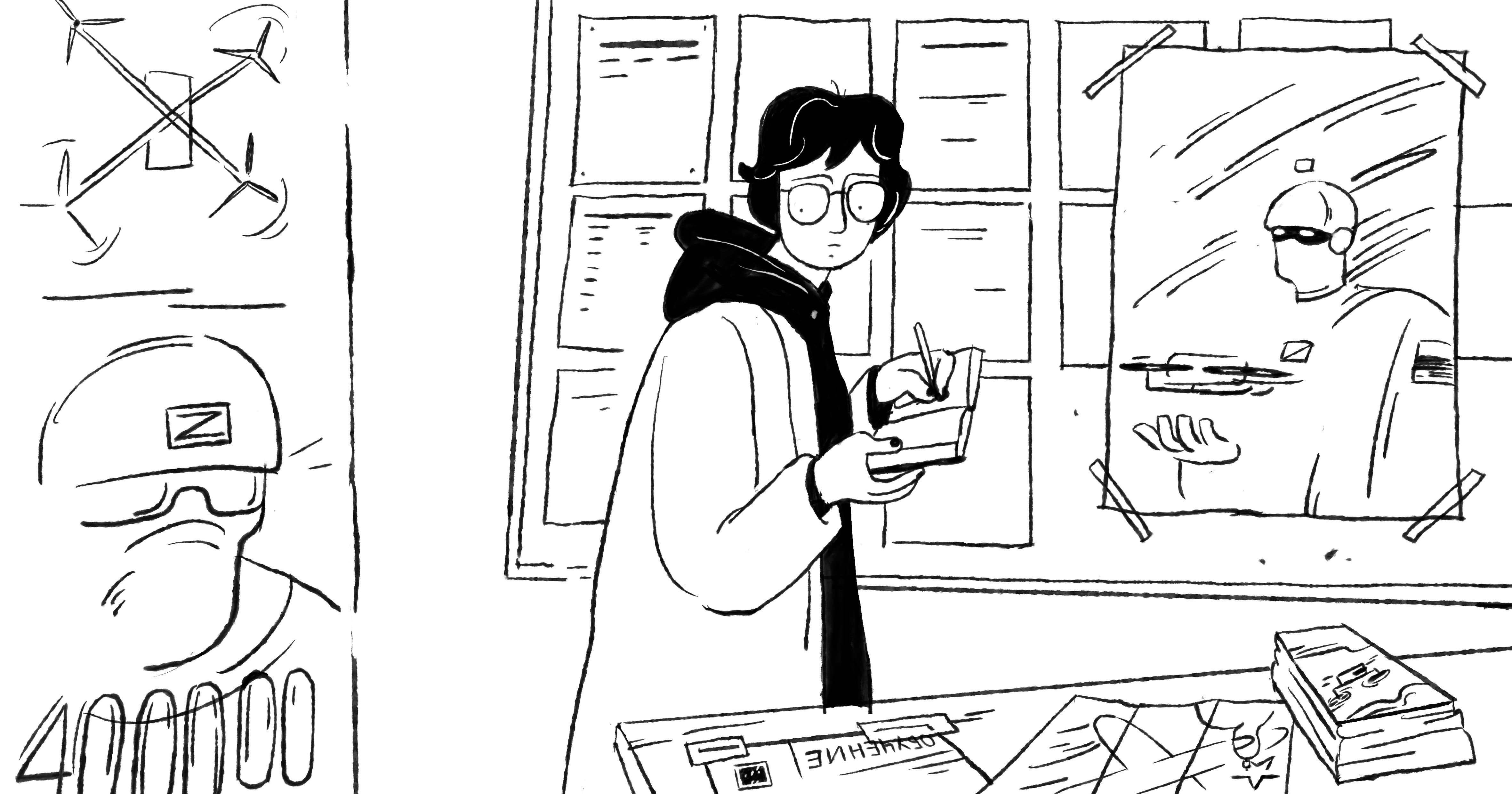
Ever since January 2026, every university building has been peppered with military pamphlets of various sizes and colors. Green ones, yellow ones, small ones, big ones, some with photos of soldiers on the cover, some without. Each one promises multimillion-ruble salaries to students if they sign a contract with the Ministry of Defense and join the Unmanned Aerial Vehicle (UAV) Troops. This particular push began in late 2025, when Dmitry Medvedev—former Prime Minister and now Deputy Chairman of the Security Council—announced that manning these forces would be a special focus in 2026. And it seems that the resource the state planned to use for this purpose were students.
Young people joining the army are promised huge salaries, debt forgiveness, and free tuition. Nevertheless, I can see that students are outraged at the efforts to push them into military service.
This month’s letter is about the militarization of Russian universities and colleges. To give you a sense of the problem’s pervasiveness, I’m going to describe a typical week at a Russian university, using my own workplace as a reference point. And then we’ll look at our daily realities within the broader context of the country.
Monday
Today my students shared that their week had once again begun with a lecture they’d been forced to attend under threat of disciplinary action. Yet another invited propagandist slash “philosopher” lecturing them about “the Russian world,” “the greatness of Russia,” and “enemy forces funded by the U.S. State Department tasked with drawing Russian youth into protests.” Ever since the start of the war in Ukraine, lectures meant to promote love for the motherland have become an integral part of the curriculum. Of course, universities had become platforms for propaganda dissemination even before 2022. But now members of the far-right nationalist organization “Russian Community,” military personnel, war correspondents, and security-service officials have all become regular guest speakers. The one thing that gives me hope is that these lecturers are fighting a losing battle for attention against the students’ phones. I’ve seen plenty of students zoning out during lectures on the “threat from the West,” while watching videos on the still-not-quite-blocked YouTube or on the “extremist platform” Instagram.
Another big factor in recent years—the Znanie society—is a propaganda project masquerading as a youth education platform. A similar organization existed back in Soviet times, and there’ve been two attempts (in 2015 and 2021) to revive it at Vladimir Putin’s behest. The second time it stuck. Znanie has featured talks from federal ministers, Elon Musk (via live link), the actor Konstantin Khabensky, and the soccer player Andrei Arshavin. Various comedians, popular bloggers, and pop performers like Vanya Dmitrienko and the rapper Basta have also made appearances. Alongside ostensibly helpful lectures on topics such as cyberbullying, Znanie regularly hosts talks with a political slant, such as this one, on Russian sovereignty and the new world order. The pro-Kremlin propaganda narratives come flawlessly packaged with clean graphics and professionally produced videos.
Recently, Znanie featured an appearance from prolific propagandist Vladimir Solovyov. This quote, in particular, made an impression on me:
“I’m [particularly] fond of two of my teachers: the one who taught history, and the one who taught basic military training. One taught me who to shoot, and the other—how to shoot.”
Tuesday
Today I got another email at my work address about collecting aid for Russian soldiers. These emails have been a regular thing since early 2022, so I don’t really read them closely anymore.
An aid collection project called Universities for the Frontline became a regular presence under the auspices of the Ministry of Science and Higher Education in 2023. In November 2023, the Ministry claimed that 500 universities had joined the project. But a 2025 analysis of the Ministry’s press-releases found that this figure had been inflated threefold. Honestly, I’m surprised that they stopped at tripling the number. I suspect that the only thing that held the Ministry of Science back was that there are only around 1000 universities in Russia, total.
Universities for the Frontline isn’t the only project aimed at involving students in collecting aid for soldiers. Often, universities collect aid in collaboration with various volunteer centers and charities. One particularly “ambitious” project, led by the organization Dobro.rf (”Kindness”), has plans to continue helping soldiers all the way to 2029. It seems they might know something we don’t…
The aid packages usually include camouflage nets (some woven by student-recruits), trench candles, medications, clothes, and toiletries. But some have included very strange (or at least highly perishable) items: a catering college sent hand pies, another sent handmade chocolates, and the Arctic State Agrotechnological University provided 12 kilos of fish cutlets.
To be honest, my own students have never once mentioned donating anything to the frontline. Even if they did, that would only mean indirect involvement in the war. Sadly, the state’s efforts don’t stop there. As I mentioned before, students are now being directly funneled into “career opportunities” that revolve around killing people.
Wednesday
Today the university administration ordered all faculty to post ads for contract service in the drone forces on their department websites. A special person who handles so-called “upbringing” at our university will be checking the posts tomorrow. Anyone who ignored the request will be reported to the university president.
In our department, I’m the one responsible for posting things to the website. Overtly disregarding this kind of assignment is difficult—I’ve seen many colleagues who refused such absurd and harmful demands get squeezed out of the university, and I can’t afford to lose my job. But I figured I could get away with some quiet sabotage. I ended up posting the ad with the phone number cropped out. So at least if you wanted to call and enlist in the drone forces, you’d have to look up their number elsewhere. No one noticed. I’m counting this as a win.
Students have been encouraged to enlist since the start of the war, but these nudges have grown a lot more frequent since 2026. In Russia, military service is required for men. Students can get deferrals through their universities’ military departments. Since the start of the war, the standard military departments have been replaced with special military training centers. Where before, students who had finished their education had options—they could serve one year as conscripts, enter the reserves through the military department, or continue on to graduate school—these centers have changed the rules. Now a student who can’t continue into grad school or obtain a medical deferral is required to sign a contract for military service. Those who decline may face fines in the millions of rubles—supposedly, these fines are meant to recoup what the state spent on the student’s military training. Keep in mind that contract service is currently an even more dangerous prospect than compulsory enlistment. The latter lasts one year, whereas a contract with the Ministry of Defense is de facto endless (more on this later). By signing it, students are effectively signing their lives away to the army.
That said, ads and blackmail aren’t the only ways they’re getting people into the army. A new, inventive technique plays on students’ love of gaming. An ad for drone-force service on the website of the Far Eastern Federal University reads: “E-sports athletes, gamers, and strategists—your time has come!” and promises bonuses in the millions for piloting drones. Alabuga Polytech college invited students to become drone operators in ads peppered with references to Hearts of Iron IV—”Smash NATO! Difficulty: very hard”—and promised a monthly stipend of 150,000 rubles. Which, by the way, is about 150 times the usual Russian university stipend. They make it sound appealing: play video games and earn a fortune. In reality, the students are being invited to destroy the infrastructure of a neighboring state and to kill real people. And unlike in a video game, once this level starts, there’s no replaying it.
In general, everything I’ve heard about Alabuga Polytech leaves me utterly bewildered. It’s often promoted by various streamers and bloggers with large followings, who describe Alabuga as a kind of teen paradise, where “the best of the best” earn “unique professions in the technology sector.” Recently Twitch, TikTok, and YouTube purged accounts that were encouraging college students to become drone assemblers, but some of them were later unblocked.
From what I’ve seen, Alabuga is a cult-like institution where teenagers are made to work around the clock. Half the day is spent studying; the rest is devoted to assembling Shahed drones late into the night. In their free time, the students play paintball games that simulate battles from World War II—except that instead of a swastika, the “bad guys” flag bears the NATO emblem. In this game, the winning team has to shoot the losing team at point-blank range, so the kids leave the “battlefield” covered in bruises. One student told journalists that after her team lost, they were forced to dig trenches in the rain.
And if you suddenly decide you don’t want to assemble drones, you can’t just leave Alabuga Polytech. The college covers students’ tuition, so upon expulsion you have to pay it back—between 170,000 and 420,000 rubles for each academic year. Most don’t have that kind of money. One 16-year-old, unwilling to stay at the college but unable to pay the enormous debt, took his own life. The boy’s father showed journalists a diary entry in which his son wrote about wanting to quit his schooling.
Thursday
Today they set up a mobile recruitment booth for the drone forces at the entrance to our building. Fortunately, no one lined up. That said, the benefits offered for risking your life are substantial. Here they are:
Money. Lots of money.
Payouts vary in size and depend on the region. Still, as a rule, they’re made up of several sizable sums. In Moscow, for example, a student joining the UAV forces can receive a one-time payout of 1.9 million rubles from the City Government, 400K from the Ministry of Defense, a monthly salary starting at 270K, and bonuses for eliminating specific targets. Knocking out a tank, for example, nets a 500K bonus. In Uray, a city in the Khanty-Mansi Region, federal, regional, and municipal payments are provided, for a total of some 4.1 million rubles.
On top of this, the universities themselves sometimes pay students for signing a contract. The largest sum I can recall seeing was promised by the Nizhny Novgorod Linguistic University—400,000 rubles. Apparently, that’s what a student’s life is worth to them.
One-year contracts.
Students are promised that, after serving just one year, they’ll get rich quick and come home safe and sound. The problem is that this is legally impossible.
A presidential decree on partial mobilization has been in force in Russia since 2022. Its end date is “until formally repealed”—something Vladimir Putin has yet to do. The decree establishes only three grounds for discharge from service during this period: health reasons, reaching the maximum age limit, and a prison sentence. Even if a particular soldier’s contract specifically states that its term is one year (which they often do, to mislead enlistees), the presidential decree takes legal precedence. In other words, in practice, soldiers cannot terminate their contracts once their year is up.
In January 2026, the administration of HSE University (the Higher School of Economics) confirmed that when students sign a contract for service in the drone forces, they’re signing on standard terms. The same was stated in April 2026 by the acting commander of the UAV forces: the command has the right to discharge a soldier after a year of service, but is not obligated to do so. So, again: the promise that students will spend no more than a year working for the war is a flat-out lie.
Service Only in the UAV Forces.
Students are promised “safe” positions, far from the line of contact. The idea is that you sit there operating drones, striking unknown targets in unfamiliar territory. The distance makes it easier to dull any sense of responsibility for the harm caused. But beyond the dubious morality of this pitch, no guarantees are actually given. There’s no assurance that students will be tasked solely with operating UAVs. Nothing stops army leadership from transferring them to another unit—including an assault unit, where the chances of survival approach zero.
Academic Leave.
A current order from the Ministry of Science grants service members two years of academic leave. But, again, this offer contradicts the partial mobilization decree and the open-ended contracts it entails. On top of that, failure to return from academic leave leads to expulsion. I assume they’ll eventually come up with something for the young “veterans” who want to continue their education, but as of now there are no legal guarantees whatsoever.
Master’s Program Placement.
A student returning from contract service can enroll in a master’s program without going through the usual admissions process, under a special quota for military personnel. Some enroll straight from the front: I already have students like that, studying remotely. Although they’re not so much “studying” as forever making excuses about internet problems. The connection at the front is apparently a bit weak.
Scholarships and Expedited Graduation.
So far, no changes have been made to federal laws or university charters that would guarantee these rights. Universities can, of course, adopt their own internal regulations and set up simplified procedures for contract soldiers, but for now these are just promises.
In general, all these privileges are guaranteed by nothing more than the recruiters’ fine words. As the saying goes, promises are made to be broken. And even the promised money may run out before a given soldier ever sees it—something that’s already happening.
Friday
I stopped by the dean’s office today to sort out a few work things with colleagues. I walked in on an instructor telling a group of students that they might soon be expelled. The bad news came with an offer, though: sign up for the drone forces, and you keep your spot at the university. I later found out that every university has contract quotas, and teachers are required to report regularly to the university presidents on whether they’re hitting their marks. I’ve also heard of some colleagues in Moscow who’ve resigned from their teaching posts rather than push students into contract service. It’s a pretty bold move—jobs are hard to come by mid-year, and there’s no guarantee you won’t run into the exact same problem elsewhere. For young academics who haven’t earned their PhD, the chances of successfully switching universities are slimmer still.
About those quotas. In 2026, Valery Falkov, the Minister of Science, announced that universities must send no fewer than 2% of their students into contract service. It’s not entirely clear, though, whether that’s per year or over a longer period. Counting only male students, that works out to 44,000 recruits. So far, the Ministry of Science has neither confirmed nor denied this goal. The only response journalists got when they asked about the 2% goal was as follows:
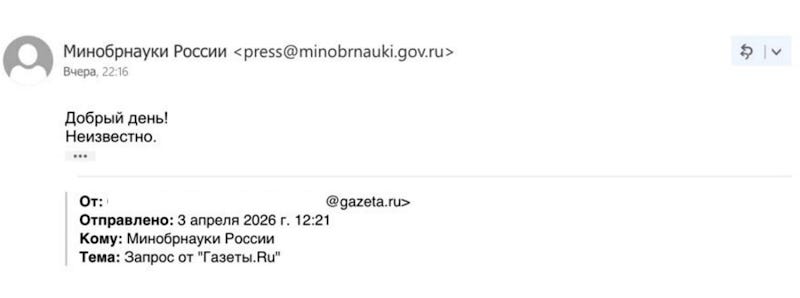
From: press@minobrnauki.gov.ru
Good day! This is unknown.
Different universities have published different target quotas for student recruits. RSUH (the Russian State University for the Humanities) has a quota of 200 students. DVFU was supposed to send 32 students in February. The recruitment target at Ural Federal University (UrFU) came to 500 students. Yet, according to reports from UrFU’s own media outlet, by April only 5 students had shown any interest in contract service. The Ministry of Science says UrFU has as many as 30,000 fully state-funded students at any given time. If these figures are to be believed, then only 0.017% of state-funded students were interested in contract service. A pretty telling number.
To boost these underwhelming results, universities resort to blackmail and the violation of students’ rights. In Russia, most universities let students re-sit an exam up to three times. At DVFU, however, students found that the window they were normally given to retake an exam had been shortened. Later, all students with academic debt—that is, those who had failed exams and were scheduled to retake them—received expulsion notices, in violation of their legal right to sit each exam three times. At a meeting with students, a representative of DVFU’s Youth Policy Department suggested that those in danger of expulsion consider signing up for military service instead.
In some cases, universities turn to rhetoric for recruitment. A few months ago, a university head told his male students that joining the war was “the social role” of men and that “God demands this of their sex.” In other words: not joining the war means you’re not a man.
At a college in Kazan, a principal told a group of students who had failed their exams that their “college days were over” and that they’d be assigned to drone warfare units. At a college in Novosibirsk, an administrator accused students of lacking patriotism and harboring a “false fear for their lives.”
Because of course—what is there to be afraid of? Better hurry up and risk your life for who knows what, at the behest of people who censor literature, block social media, and steal from the state to build themselves palaces.
In any case, this kind of news circulates only through opposition-minded Telegram channels. The Ministry of Defense officially denies that students are being driven toward expulsion as a way to force them into military contracts.
Saturday
Today I read the news about the death of a student who had been fighting in the drone forces. It’s the first known case. According to the journalists who investigated the story, Valery Averin was a senior at a technical college in Buryatia and signed a contract with the Ministry of Defense in January. On April 2, he told his foster mother that he was leaving for somewhere with no phone signal. She told journalists that Valery had initially been turned away from service on grounds of mental unfitness, but in the end he somehow signed a contract without saying a word to his family. The young man was killed on April 6 near Luhansk in a mortar strike.
I can’t imagine the grief Valery’s mother must feel. I really want as many students as possible to hear about this: this young man died in an active combat zone—not in the rear, far from the action, where drone operators are promised they’ll be posted.
Sunday
On my one and only day off, I spent some time on TikTok. But there’s no peace there either, because my recommended feed is full of videos of students talking about the ways they’re being pushed into contract service. They’re angry and bewildered.
Even publicly available polls—that is, state-sanctioned ones—show that most students don’t want to fight. In 2022, when the “partial mobilization” was first announced, one state-run media outlet published a survey of public support for the decision. Fifty percent of respondents between the ages of 18 and 26 did not back the mobilization. In April 2024, the independent research organization Levada Center reported that 61% of those surveyed aged 18 to 24 were in favor of starting peace negotiations.
Students have become an important resource for the state—and they’re directly affected by every political decision, from war recruitment to internet shutdowns. As it turns out, in the eyes of the state, a young person’s life is worth a few million rubles. More than anything, I want this to end soon—the way young people are dehumanized and turned into fuel for the state’s deranged decisions.
…